

For decades, small business owners have been told that CRM (Customer Relationship Management) is their system of record. But in 2026, a system of record isn't enough. As industry visionary, veteran CRM analyst and SMB expert, Brent Leary, has frequently pointed out, the future of business isn't found in a static database; it’s found in the conversations that happen around that data.
We are entering the era of the invisible CRM, where AI handles the logistics of the relationship so the business owner can focus on the emotion of the relationship. Here is how small businesses are redesigning their workflows to win in the age of conversational intelligence.
1. From digital Rolodex to relationship intelligence
The old way of using a CRM involved manual data entry—logging every call, tagging every lead and setting reminders. It was tedious, and frankly, most small business owners didn't do it consistently.
The AI shift: Today’s systems use conversational intelligence. Instead of you telling the CRM what happened, the CRM listens (via integrated meeting tools and email agents) and tells you what matters.
Sentiment analysis: AI can now flag at-risk customers by detecting shifts in their tone during a support chat.
Contextual history: When a customer calls, your AI co-pilot doesn't just show you their last purchase; it summarizes their last three interactions across Instagram, email and phone, giving you the context to say, "I'm so glad your daughter's graduation went well! How can I help you today?"
2. The rise of "agentic" customer journeys
The most significant trend Brent Leary has identified recently is the move toward AI Agents that actually do the work. For a small business, this is like having a 24/7 sales and operations team that never sleeps.
The proactive outreach agent: In the past, you waited for a customer to reach out. Now, AI agents analyze buying patterns. If a client usually orders supplies every 45 days and hasn't on day 50, the agent drafts a personalized check-in message for you to approve.
The multimodal experience: Customers now expect to seamlessly interact via voice, text and video seamlessly. AI-powered voice bots are no longer robotic; they are sophisticated enough to handle appointment booking or basic troubleshooting, allowing the small business to scale without losing the local feel.
3. The small business buzz: authenticity as a moat
As AI makes it easier to generate content, the internet is becoming flooded with generic noise. Brent Leary often speaks about the "Small Business Buzz"—that unique energy that only a founder can provide.
Don't automate the soul: Use AI to draft the invoices, schedule the posts and summarize the meetings. But never use AI to handle a customer’s moment of truth — the apology for a mistake, the celebration of a milestone or the deep-dive strategy session.
Transparent automation: In 2026, customers value transparency. Being honest about using AI to help provide faster service actually builds trust, as long as a human is always one click away.
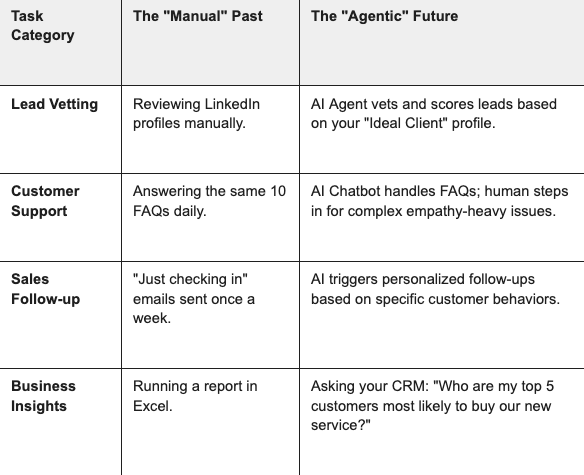
4. Redesigning your workflow for the "Engagement Era"
To integrate this into your daily routine, you have to stop thinking of AI as a tool and start thinking of it as a team member.
The bottom line: technology changes, relationships don't
The tools we use have evolved from ledger books to spreadsheets to AI Agents, but the core of small business remains the same: trust. Small businesses that win in 2026 won't be the ones with the most advanced algorithms; they will be the ones that use those algorithms to free up enough time to be truly, deeply human with their customers.