
For the vast majority of established garage door contractors, Angi (formerly HomeAdvisor) is no longer worth the investment due to low lead quality, hyper-competitive price wars and aggressive annual contracts.
While the platform can occasionally serve as an emergency jumpstart for brand new technicians who have zero web presence, most garage door companies find that buying shared leads from third-party aggregators yields an exceptionally high cost per acquired customer.
When a homeowner's garage door spring breaks or their door comes off its tracks, they are facing an immediate crisis. They do not want to fill out a detailed form on an aggregator site and get hounded by four different phone calls within thirty seconds. They want to click a button, talk to a dispatcher and get a technician to their house today.
Understanding why Angi fails to deliver strong returns for garage door repair requires breaking down the mechanics of the shared lead model, the reality of contractor close rates and the math behind alternative ad platforms.
The structural problem: the shared lead model vs. emergency repairs
The core business model of Angi relies on selling the exact same homeowner inquiry to multiple competing contractors simultaneously. Depending on your market, a single garage door lead submitted through their portal might be resold to three to five different local repair companies at $25 to $75+ per lead.
This creates a structural mismatch when applied to garage door services:
The homeowner submits a form on Angi ----> the lead is sold to four different contractors ----> four technicians call the homeowner within 60 seconds ----> there's a price race to the bottom/the homeowner overwhelms and disengages.
When a customer receives four automated text messages and four immediate phone calls from competing contractors, two negative outcomes typically occur:
The race to the bottom: The customer treats the situation like a commodity auction, asking each contractor, "What is your service call fee?" The job almost always goes to the lowest bidder who is willing to slash their margins.
Contact friction: Panicked customers who wanted a quick fix become overwhelmed by the sheer volume of calls. Many refuse to answer the phone altogether, leaving you paying $50 for a contact who ghosted you.
The real cost math: CPL vs. cost per acquired customer
Marketing agencies and lead brokers love to pitch low cost per lead (CPL). They will tell a garage door business owner, "We can get you garage door repair leads for just $35 each!"
However, CPL is a vanity metric. The only metric that determines whether your business makes money is your Cost Per Acquisition (CPA)—the total amount of marketing money spent to put an actual paying job on your schedule.
Because shared marketplace leads put you in direct competition with multiple other companies on speed and price, closing rates on platforms like Angi typically hover around 5% to 8%.
Compare the true unit economics of shared leads versus exclusive lead channels:
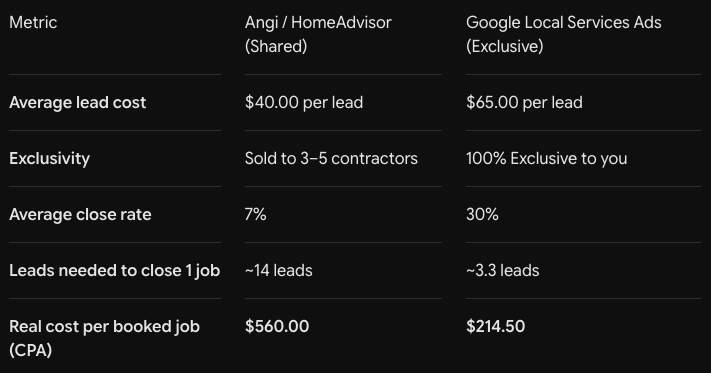
Even though the upfront cost per lead appears cheaper on Angi, you end up paying more than double the price to actually secure a paying customer.
The hidden contract traps and fine print
Beyond poor conversion math, the most frequent complaint from garage door contractors regarding Angi involves contract terms and billing practices.
Many contractors sign up during a sales call believing they are simply buying a flexible bucket of leads to test out for a month. In reality, the fine print often includes severe operational constraints:
1. Annual contract lock-ins
Angi frequently requires contractors to commit to a 12-month advertising agreement. If you realize after two months that the leads are unworkable or out of your service territory, canceling early often triggers cancellation fees amounting to 35% of the remaining contract balance.
2. The "zombie lead" phenomenon
Contractors frequently report being charged for invalid inquiries. These include homeowners looking for DIY advice, renters who do not have authority to authorize repairs, wrong phone numbers or people looking for commercial door work when you only do residential repairs. While credit request systems exist, disputing bad leads can turn into an administrative burden.
3. Renting your reputation instead of building equity
When you pay for leads on third-party aggregators, you are helping Angi rank higher on search engines while building their brand assets. The moment you stop paying their monthly fee, your lead flow drops to zero instantly. You do not build any long-term domain authority or permanent organic ranking for your own business.
Where garage door contractors should spend their marketing budget instead
If third-party lead generation platforms yield poor returns, where should a growing garage door business allocate its ad spend? The top-performing contractors focus on channels that capture high-intent customers exclusively.
Google Local Services Ads (LSAs)
Local Services Ads sit at the absolute top of Google search results, above traditional pay-per-click ads and map packs.
Why it wins: You only pay when a customer directly calls your shop or sends a direct message.
The benefit: If a caller asks for something you don't do (like commercial gates) or calls from outside your ZIP code radius, you can flag the call and get a credit directly from Google.
Local search engine optimization and Google Map Pack
Over 70% of local emergency service calls go to the top three businesses featured in the Google Map Pack.
Why it wins: These organic calls are completely free.
The benefit: Investing in getting real customer reviews, optimizing your primary categories (e.g., "Garage Door Repair Service") and building local citations creates a compounding asset that generates leads for years without per-lead fees.
Hyper-targeted Google Search Ads (PPC)
Running direct search campaigns to dedicated, high-converting landing pages gives you total control over messaging.
Why it wins: You own the traffic. By using strict negative keyword lists (blocking terms like "manual," "parts," "DIY" or "how to fix"), you ensure that every dollar spent goes directly toward homeowners seeking professional help.
When is Angi actually worth considering?
Despite the drawbacks, there is one narrow scenario where using Angi makes sense: A brand new, solo-operator technician with zero online footprint and immediate cash needs.
If you just bought a truck, stocked it with springs and rollers, and have no website or Google reviews, you cannot wait three months for local SEO to kick in. In this specific context:
Use shared leads purely as a temporary bridging strategy to get quick cash flow.
Answer every lead within 30 seconds. If you do not call within one minute, do not bother buying the lead.
Over-deliver on service and immediately ask every completed job for a review on your own Google Business Profile.
Transition off the platform as soon as your organic and direct ad channels begin producing steady volume.
Is Angi / HomeAdvisor still worth it for garage door leads? No.
Garage door repair is a high-intent, emergency-driven service. Attempting to acquire emergency customers through a shared, multi-contractor bidding bazaar creates friction, inflates customer acquisition costs and erodes profit margins.
Contractors looking for sustainable growth should stop renting leads from aggregators and instead invest directly in channels they control: Google Local Services Ads, direct search campaigns and local map optimization.
Ready to take your garage door marketing to new heights? Contact us today!