
Building trust at scale with educational video advertising
Patients have become immune to generic new patient specials and stock photos of perfect smiles. The most effective way to capture high-value cases today is through "Clinical Explainer" Ads. These are short, high-impact videos where you—the doctor—directly address a patient's pain point, explain the solution and demonstrate your expertise before they even set foot in your office.
A clinical explainer ad isn't a commercial; it’s a mini-consultation. Here is your blueprint for creating dental ads that build authority and drive high-production cases.
1. The hook-problem-solution framework
A clinical explainer ad must be concise, usually between 40 and 75 seconds. To keep viewers from scrolling past, follow this specific script structure:
The hook (0-5 seconds): Address the symptom or fear immediately.
Example: "Is a missing tooth making it hard to eat the foods you love?"
The problem (5-20 seconds): Briefly explain the clinical consequence of inaction.
Example: "When a tooth is lost, the surrounding bone begins to shrink, which can lead to further tooth loss and a sagging facial appearance."
The solution (20-45 seconds): Introduce the treatment and the technology you use.
Example: "In our office, we use 3D-guided implant technology to replace missing teeth with precision, often in just one visit."
The call to action (45-60 seconds): Tell them exactly what to do next.
Example: "Click below to download our 'Guide to Dental Implants' and book your digital scan today."
2. The handheld aesthetic
In 2026, "unpolished" is the new "professional." Patients trust videos that look like they were filmed by a real person on a smartphone rather than a film crew.
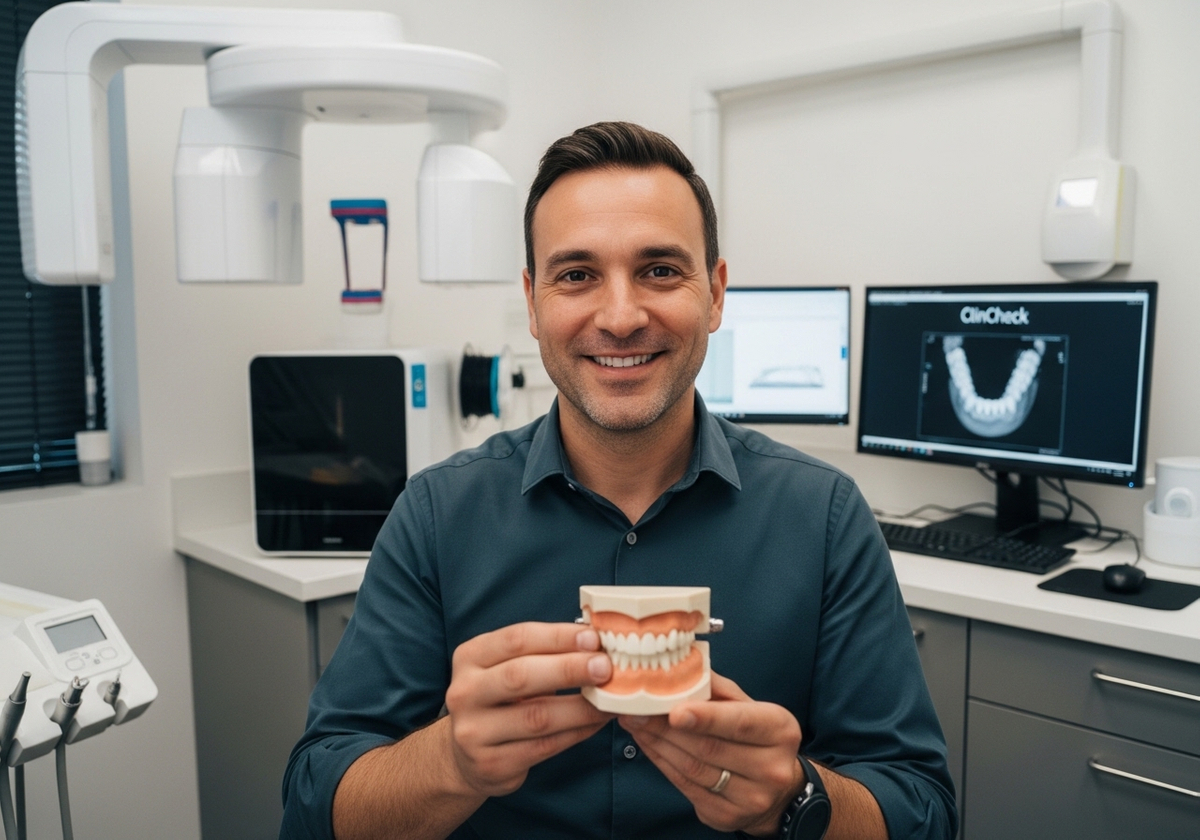
The setting: Film in your operatory or in front of your technology (like your 3D printer or CBCT scanner). This provides visual social proof of your clinical environment.
The delivery: Speak directly into the lens. Don't use a teleprompter; it makes you look rehearsed. It’s okay to stumble slightly or use natural hand gestures—it makes you human and approachable.
3. Demonstrate diagnostic proof
Show, don't just tell. If you are talking about dental implants, hold an implant model. If you are talking about Invisalign, show a digital "ClinCheck" scan on your monitor.
Technology as a character: By featuring your advanced equipment in the background or as a prop, you are non-verbally communicating that your practice is at the forefront of the field. This justifies higher treatment costs in the patient's mind.
4. Deploying with diagnostic intent targeting
The best video in the world won't work if it's shown to the wrong person.
Targeting symptoms: Use Google and Meta's AI-driven targeting to show your "root canal explainer" to people searching for "toothache relief" or "swollen gums."
Retargeting: If a patient visits your "Implants" page but doesn't book, show them your "Clinical Explainer" video as a follow-up ad. It acts as a gentle, educational reminder of your expertise.
How Marketing 360® can help
Producing and placing video ads can be overwhelming for a busy dentist. Marketing 360 streamlines this process by helping to identify which procedures have the highest search volume in your area, provide you with proven script templates and handle the complex AI-targeting across Google, YouTube and Meta. With Marketing 360, your "Clinical Explainers" reach the exact patients who are looking for your expertise, turning your ad budget into a high-ROI growth engine. Contact us today!