

For decades, one of the fundamental promises of buying a franchise has been simple: You are buying the power of an established brand. Brand recognition. Proven systems. Marketing resources. A website. National advertising. Corporate support.
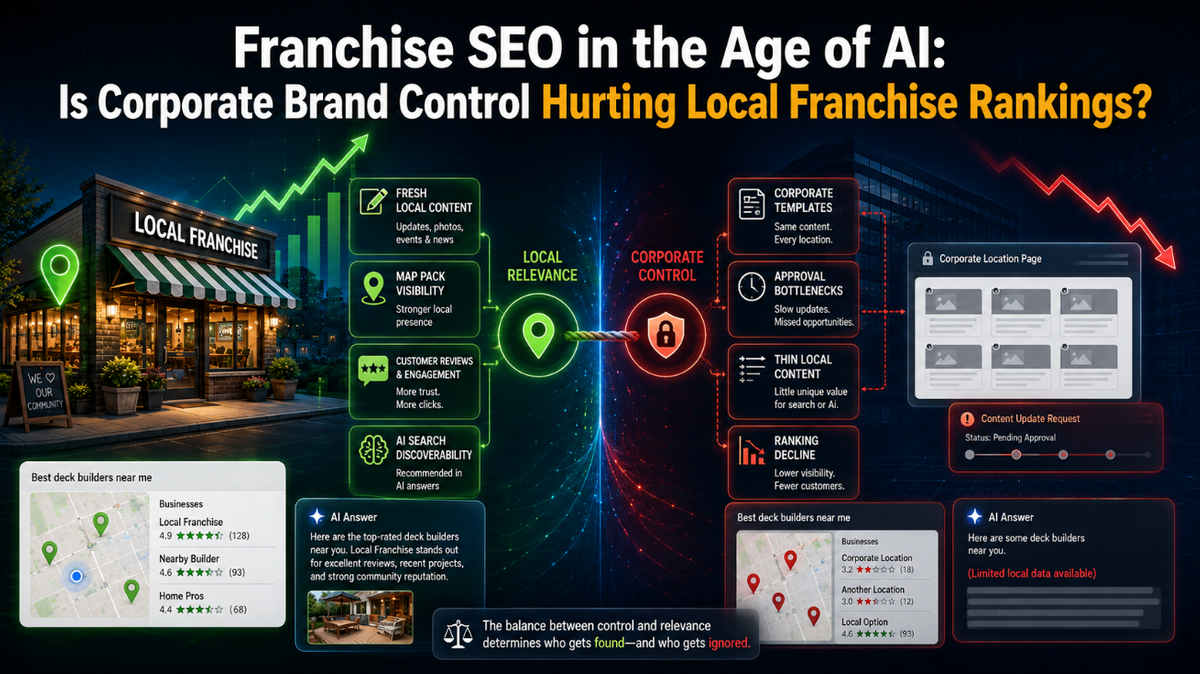
But the way consumers find local businesses is changing so rapidly that one of the traditional strengths of the franchise model may now be creating an unintended weakness.The digital controls designed to protect the national brand can prevent individual franchise locations from building the local authority they need to compete in Google and AI-powered search.
That should concern every franchisor — and every franchisee paying royalties and marketing fees with the expectation that the brand will help them win their local market.
The way consumers search for local businesses has fundamentally changed
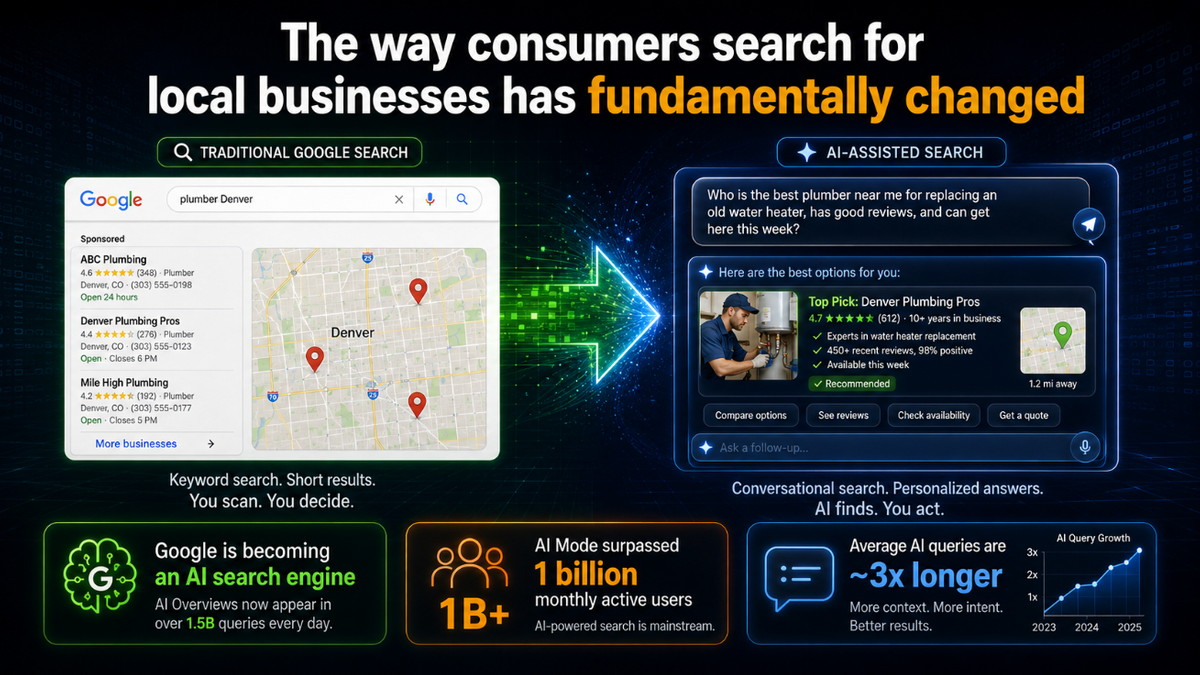
Google isn't disappearing. But Google itself is becoming an AI search engine.
In May 2026, Google reported that AI Mode had surpassed one billion monthly active users, with queries more than doubling every quarter since launch. Google also says the average AI Mode query is roughly three times as long as a traditional Google search.
Consumers aren't just typing: “plumber Denver.” They're increasingly asking questions such as: “Who is the best plumber near me for replacing an old water heater, has good reviews, and can get here this week?”
And it isn't happening only inside Google.
BrightLocal's 2026 Local Consumer Review Survey found that 45% of consumers had used AI tools for local business recommendations, compared with just 6% the year before. AI had already become the third-most-used source for local business recommendations, behind only Google and Facebook.
That's a massive behavioral shift in a very short period.
Yet many franchise websites are still built for the search environment of 10 years ago
Look at the digital footprint of many large franchise systems. There is a beautifully designed corporate website. Then there is a location finder. Click a location and you arrive on something like: brand.com/locations/denver.
It might contain:
The location's name, address and phone number.
Corporate-approved service descriptions.
A map.
A contact form.
Perhaps a few generic reviews.
Then look at another franchise location 50 miles away. Much of the page is identical. Another state? Same thing. Sometimes the city name and contact information are essentially the only meaningful differences. That architecture makes perfect sense from a brand-control perspective. It's easy to manage. It's compliant. Nobody can publish something corporate doesn't approve.
But there's another side of the equation: What does it give Google or an AI system that proves this specific franchise location is one of the most relevant businesses in that community?
Google is telling businesses what it wants
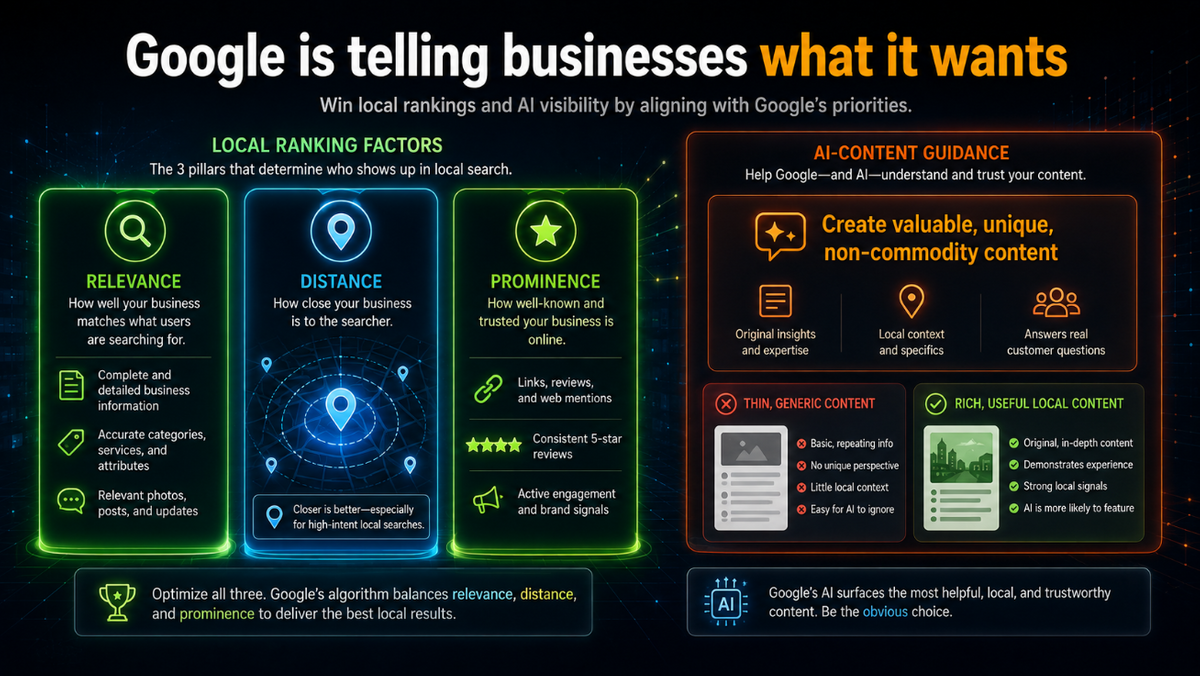
Google says local rankings are primarily influenced by three factors: relevance, distance and prominence.
For relevance, Google specifically encourages businesses to provide complete and detailed information so Google can better understand the business and match it to searches. Prominence also incorporates information Google finds elsewhere on the web, including links and reviews.
Now Google is giving similar guidance for AI search. In 2026, Google published new guidance for appearing in generative AI search experiences. One of its primary recommendations? Create valuable, unique, non-commodity content.
Google specifically emphasizes first-hand experience, original viewpoints, and content that goes beyond information that could easily be produced by anyone — or by an AI model.
Think about what that means for franchise marketing.
A page that says: “ABC Roofing proudly serves Denver and the surrounding area. Contact us today for all your roofing needs” is commodity information. Almost anyone can say it.
Compare that with a local independent roofing company publishing:
Photos from recent Denver roofing projects.
Information about hail damage following a local storm.
Neighborhood-specific roofing considerations.
Local building-code questions.
Customer stories.
Videos from local jobs.
Employee profiles.
Denver-area FAQs.
Community sponsorships.
Locally generated reviews.
Which business provides search engines more evidence that it actually knows — and serves — Denver?
The answer seems obvious.
The independent SMB has an advantage franchises rarely talk about
This is where the franchise model gets interesting. Imagine two competing businesses. One is an independent HVAC company. The owner can walk onto a job Monday morning, take pictures, write about the problem that afternoon, publish the case study Tuesday and answer customer questions on the website Wednesday. They can create pages addressing issues customers in that particular community are actually experiencing.
The franchise owner across town may know just as much about HVAC. They may have operated in the community for 15 years. They may have hundreds of satisfied customers. But their digital presence could still consist of a corporate location page containing almost exactly the same content as 200 other franchise locations.
Why? Because corporate controls the website. The franchisee isn't allowed to change it. And that creates what I call the Franchise Visibility Paradox:
The franchisee buys the strength of a national brand, but the controls designed to protect that brand can prevent the franchisee from building the local digital authority required to win modern search.
Industry practitioners are beginning to identify the same problem.
A 2025 Entrepreneur article examining SEO across more than 70 franchise locations argued that many franchise location pages are thin, duplicate, template-driven and lacking substantial local value. The recommended alternative wasn't abandoning the franchise brand — it was building genuinely unique, localized pages for individual locations.
Search Engine Land makes a similar argument: location pages for chains and franchises should extend far beyond name, address and phone number and instead provide information relevant to the products, services and geography of each individual branch.
More location pages aren't necessarily the answer
There's an important distinction here. I am not arguing that every franchise should create hundreds of city pages stuffed with keywords. That could make things worse.
Search Engine Land recently warned multi-location businesses that simply generating more geographic pages does not necessarily increase local visibility. Poorly differentiated pages can create internal competition, fragmented authority, inconsistent information and enormous maintenance problems.
Google similarly warns against mass-producing content that provides little independent value.
Its people-first content guidance explicitly asks website owners whether content is being mass-produced or spread across a large network in a way that causes individual pages to receive less attention and care.
So changing: Denver → Boulder → Fort Collins → Colorado Springs inside the same 500-word template isn't hyper-local marketing. It's find-and-replace.
AI search makes the stakes even higher
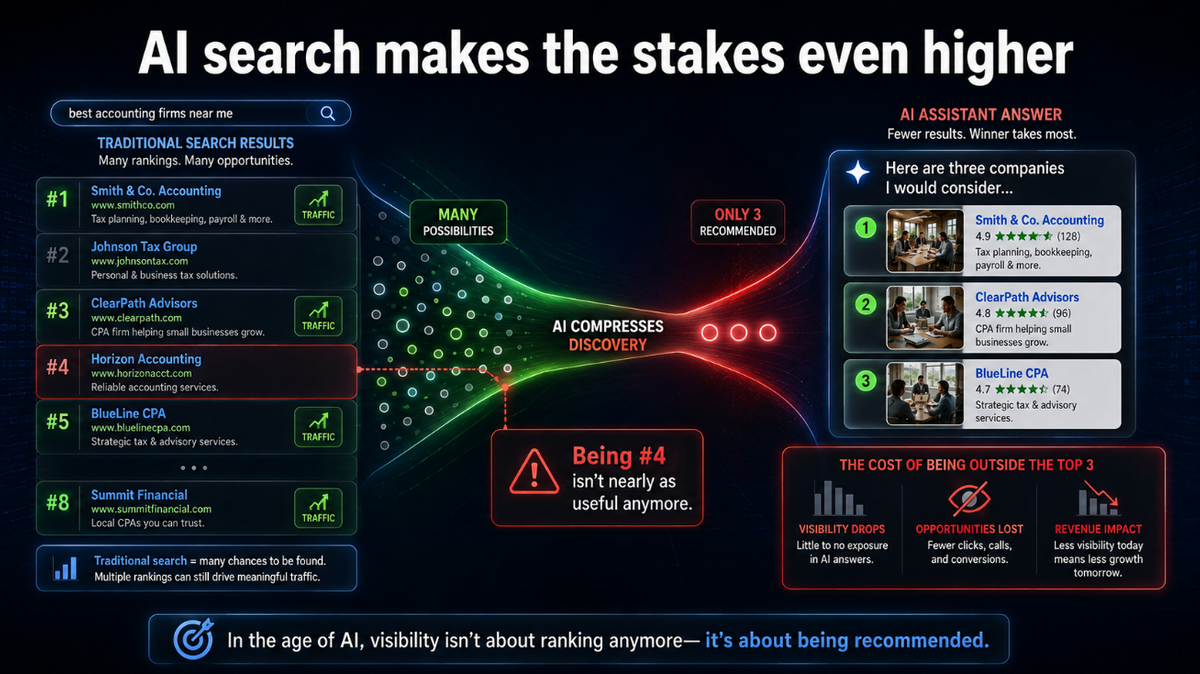
Traditional Google search gave businesses multiple opportunities to be discovered. Ranking #3, #5 or even #8 could still produce traffic. AI potentially compresses that consideration set dramatically.
Instead of showing ten blue links and asking the consumer to research businesses themselves, an AI assistant may answer: “Here are three companies I would consider…” Being fourth isn't nearly as useful anymore.
Research from Pew Research Center demonstrates how dramatic this change could become. Pew analyzed Google search behavior and found that users who encountered an AI summary clicked a traditional search result in only 8% of visits, compared with 15% when no AI summary appeared.
The goal is therefore beginning to change from: “How high do we rank?” to: “Does the search engine understand enough about our location to consider recommending us at all?”
And local evidence becomes extremely important.
This doesn't mean corporate websites are dead
There is an important nuance franchisors shouldn't miss. This isn't really an argument about corporate website vs. franchisee website. And it isn't simply subdomain vs. subdirectory.
Google doesn't magically reward a page because it resides on a subdomain.
A well-built brand.com/denver page can absolutely perform. A terrible denver.brand.com site can absolutely fail. The real issue is digital autonomy and content depth.
Can each franchise location develop a meaningful digital presence around the community it actually serves?
Can it publish unique local expertise?
Can it document local work?
Can it answer local customer questions?
Can it showcase local staff?
Can it build local reviews and citations?
Can it continuously improve that information without waiting six months for a national website redesign?
That's the real question.
Even the International Franchise Association has argued that franchise brands need to think beyond traditional SEO as AI search grows, emphasizing individual locations as sources of local data supported by websites, Google Business Profiles, reviews, and community mentions.
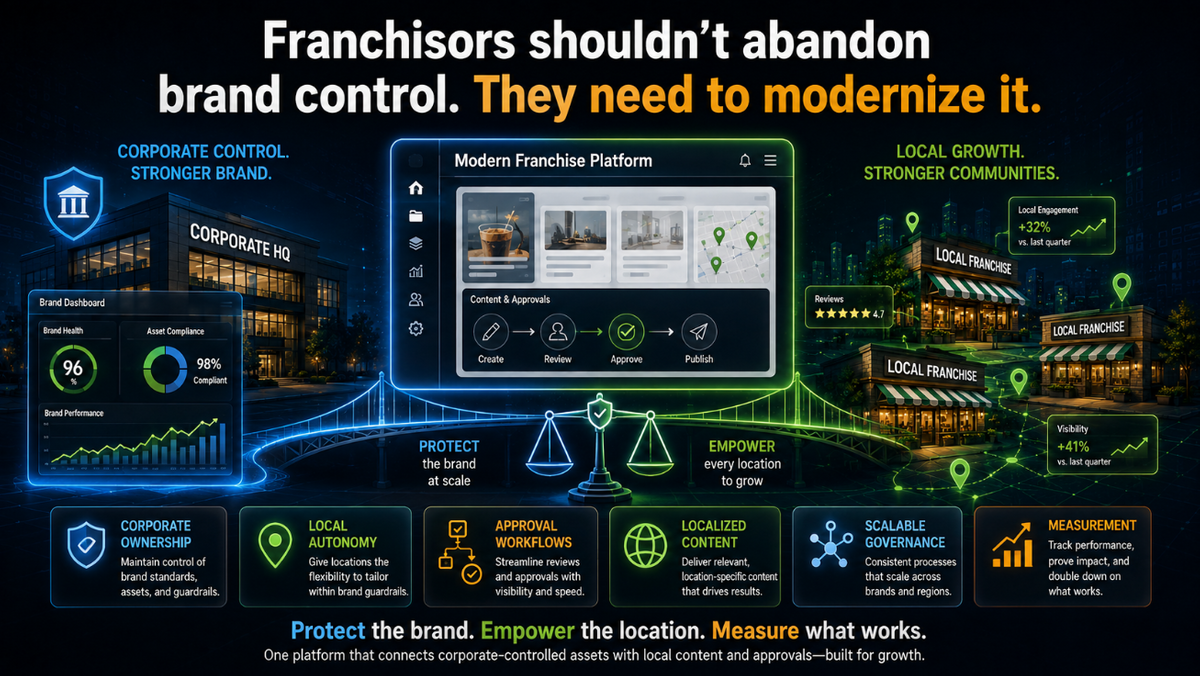
Franchisors shouldn't abandon brand control. They need to modernize it.
The franchise industry should be testing this now
I don't believe anyone can yet claim to know exactly what franchise search visibility will look like five years from now. AI discovery is changing too quickly. But we already know enough to ask a difficult question:
If the independent business down the street is allowed to create hundreds of authentic signals proving its local expertise while your franchisee gets one largely static corporate location page, who will Google and AI eventually understand better?
For franchisors, this isn't simply an SEO question. It's a franchisee-economics question.
Franchisees pay royalties because the system is supposed to provide advantages they couldn't easily reproduce independently. If corporate marketing restrictions eventually make a location less capable of competing for local discovery than an independent SMB, the industry has a problem.
Protecting the brand still matters. But in the age of AI search, protecting the brand cannot mean making the local business invisible. The next generation of franchise marketing needs to accomplish both:
Lock the brand. Unlock the local market.